

What Does The Clean Water Act Do For Our Drinking Water
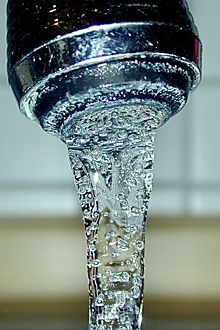
Drinking water or potable water is water pure plenty to be consumed or used with low risk of firsthand or long term harm. In about developed countries, the water supplied to households, commerce and industry is all of drinking water standard, even though merely a very small proportion is actually consumed or used in food preparation. Typical uses include washing or landscape irrigation.
Over large parts of the earth, humans have inadequate access to potable water and use sources contaminated with disease vectors, pathogens or unacceptable levels of toxins or suspended solids. Such h2o is non wholesome, and drinking or using such water in food preparation leads to widespread acute and chronic illnesses and is a major cause of expiry and misery in many countries. Reduction of waterborne diseases is a major public health goal in developing countries.
H2o has always been an important and life-sustaining beverage to humans and is essential to the survival of all organisms. [1] Excluding fat, water composes approximately seventy% of the human body by mass. It is a crucial component of metabolic processes and serves equally a solvent for many bodily solutes. The United States Environmental Protection Agency in gamble assessment calculations assumes that the average American adult ingests two.0 litres per 24-hour interval. [2] Drinking water of a variety of qualities is bottled. Bottled h2o is sold for public consumption throughout the earth.
Contents
- 1 Requirements
- two Access
- 3 Improving availability
- 3.ane Well contagion
- 3.ii Diarrhea as a major wellness effect amidst children
- 4 H2o quality and contaminants
- four.ane Safety Indicators
- 4.2 H2o Treatment
- 5 Drinking water regulation
- 5.1 European Marriage
- 5.2 United states of America
- 6 Drinking water preferences of other animals
- 7 See also
- 8 References
- 9 External links
Requirements
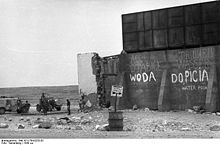

Potable water source in the Sahara Desert marked in Italian, German, Polish and English language
Main article: Fluid balance
Health authorities accept historically suggested at least eight glasses, viii fl oz each (240 mL), of h2o per day (64 fl oz, or one.89 litres), [3] [ii] and the British Dietetic Association recommends i.8 litres. [1] . This common misconception is non supported by scientific research. Diverse reviews of all the scientific literature on the topic performed in 2002 and 2008 could not find any solid scientific evidence that recommended drinking eight glasses of water per day. [four] [five] [vi] In the U.s., the reference daily intake (RDI) for h2o is three.7 litres per day (L/twenty-four hour period) for homo males older than 18, and 2.seven L/day for homo females older than 18 [7] including h2o contained in food, beverages, and drinking water. The amount of water varies with the private, as it depends on the condition of the subject, the amount of concrete do, and on the environmental temperature and humidity. [8] An individual'south thirst provides a better guide for how much water they require rather than a specific, fixed quantity.
In terms of mineral nutrients intake, it is unclear what the drinking water contribution is. Nevertheless, inorganic minerals generally enter surface water and ground water via tempest water runoff or through the Earth's crust. Treatment processes as well lead to the presence of some minerals. Examples include calcium, zinc, manganese, phosphate, fluoride and sodium compounds. [9] H2o generated from the biochemical metabolism of nutrients provides a significant proportion of the daily water requirements for some arthropods and desert animals, only provides just a small fraction of a human'southward necessary intake. In that location are a variety of trace elements nowadays in virtually all beverage water, some of which play a role in metabolism. For instance sodium, potassium and chloride are common chemicals found in small-scale quantities in near waters, and these elements play a role (non necessarily major) in trunk metabolism. Other elements such as fluoride, while beneficial in low concentrations, tin can cause dental bug and other bug when present at loftier levels. H2o is essential for the growth and maintenance of our bodies, as it is involved in a number of biological processes.
Profuse sweating can increment the demand for electrolyte (salt) replacement. Water intoxication (which results in hyponatremia), the process of consuming too much water as well quickly, can be fatal. [10] [11]
Access

Just forty-six percent of people in Africa have safe drinking water.
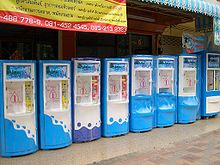
Drinking water vending machines in Thailand. One litre of purified h2o is sold (into the customer'southward own bottle) for 1 baht.
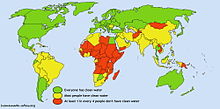
H2o quality - pct of population using improved water sources past land
Although covering some 70% of the Earth'southward surface, most water is saline. Freshwater is bachelor in most all populated areas of the earth, although it may be expensive and the supply may not always be sustainable. Sources where h2o may be obtained include:
- footing sources such every bit groundwater, hyporheic zones and aquifers.
- atmospheric precipitation which includes rain, hail, snow, fog, etc.
- surface water such as rivers, streams, glaciers
- biological sources such every bit plants.
- the ocean through desalination
- Water supply network
Bound water, a natural resource from which much bottled water comes, generally contains minerals. [12] Tap h2o, delivered by domestic h2o systems in developed nations, refers to water piped to homes through a tap. All of these forms of water are unremarkably drunkard, often purified through filtration. [thirteen]
The well-nigh efficient fashion to ship and evangelize drinkable water is through pipes. Plumbing can crave significant upper-case letter investment. Some systems suffer high operating costs. The cost to replace the deteriorating water and sanitation infrastructure of industrialized countries may exist equally high equally $200 billion a year. Leakage of untreated and treated water from pipes reduces admission to water. Leakage rates of l% are non uncommon in urban systems. [fourteen]
Because of the high initial investments, many less wealthy nations cannot afford to develop or sustain appropriate infrastructure, and as a consequence people in these areas may spend a correspondingly higher fraction of their income on water. [15] 2003 statistics from El Salvador, for case, indicate that the poorest 20% of households spend more x% of their total income on water. In the United Kingdom authorities define spending of more than iii% of ane's income on water as a hardship. [16]
The Millennium Development Goal of halving the proportion of people without access to safe drinking water between 1990 and 2022 will probably exist reached. Some countries though however face up enormous challenges. [17]
Rural communities are the furthest from meeting the 2022 MDGs drinking water target. Globally only 27% of the rural population has water piped directly to their home and 24% rely on unimproved sources. Of the 884 million people without admission to an improved water source, 746 million people (84%) live in rural areas. Sub-Saharan Africa has made the to the lowest degree progress in improved water sources since 1990, improving only 9% to 2006. In contrast, the Eastern Asian region saw a dramatic drop from 45% to nine% reliance on unimproved h2o in the same time catamenia. [xviii]
| Land | % | Country | % | Land | % | Country | % | State | % | ||||
|---|---|---|---|---|---|---|---|---|---|---|---|---|---|
| Albania | 97 | People's democratic republic of algeria | 89 | Republic of azerbaijan | 78 | Brazil | 87 | Chile | 93 | ||||
| China | 75 | Republic of cuba | 91 | Arab republic of egypt | 97 | India | 84 | Indonesia | 78 | ||||
| Iran | 92 | Iraq | 85 | Kenya | 57 | N Korea | 100 | South korea | 92 | ||||
| United mexican states | 88 | Moldova | 92 | Kingdom of morocco | eighty | Mozambique | 57 | Islamic republic of pakistan | 90 | ||||
| Republic of peru | eighty | Philippines | 86 | Singapore | 100 | South Africa | 86 | Sudan | 67 | ||||
| Syria | 80 | Turkey | 82 | Uganda | 52 | Venezuela | 83 | Republic of zimbabwe | 83 | ||||
| Note: All industrialized countries (equally listed by UNICEF at 2000) with data available are at 100%. |
In the U.S, the typical nonconserving unmarried family home uses 262 L of water per capita per day. In some parts of the country there are water supplies that are dangerously low due to drought, particularly in the West and the South Due east region of the U.Due south. [20]
Improving availability

1 of the Millennium Development Goals (MDGs) prepare by the UN includes environmental sustainability. In 2004, only forty-two percent of people in rural areas had access to clean water. [21]
Solar water disinfection is a low-cost method of purifying water that can ofttimes exist implemented with locally bachelor materials. [22] [23] [24] [25] Unlike methods that rely on firewood, it has low affect on the environment.
1 organisation working to improve the availability of condom drinking water in some the earth's poorest countries is WaterAid International. Operating in 26 countries [26] , WaterAid is working to brand lasting improvements to peoples' quality of life past providing long-term sustainable admission to make clean water in countries such as Nepal, Tanzania, Republic of ghana and India. It also works to brainwash people about sanitation and hygiene. [27]
The Global Framework for Action (GF4A) is an organisation that brings together stakeholders, national governments, donors and NGOs (such as H2o aid) to define manageable targets and deadlines. 23 Countries are off-rail to meet the MDG goals for improved water availability. [28]
Well contamination
Some efforts at increasing the availability of safe drinking water have been disastrous. When the 1980s was alleged the "International Decade of Water" by the United Nations, the supposition was fabricated that groundwater is inherently safer than water from rivers, ponds, and canals. While instances of cholera, typhoid and diarrhea were reduced, other problems emerged. In Bharat for example, 60 meg people are estimated to have been poisoned by well water contaminated by excessive fluoride, which is dissolved from the granite rocks. The effects are specially evident in the os deformations of children. Like or larger problems are anticipated in other countries including China, Uzbekistan, and Ethiopia. Although helpful for dental health in low dosage, fluoride in big amounts interferes with bone formation. [29]
In a related problem, it is estimated that half of the Bangladesh's 12 million tube wells contain unacceptable levels of arsenic due to the wells not being dug deep enough (past 100 M). The Bangladeshi government had spent less than $7 million of the 34 1000000 allocated for solving the trouble past the World Depository financial institution in 1998. [29] [xxx] Natural arsenic poisoning is a global threat, 140 million people affected in 70 countries on all continents. [31] These examples illustrate the need to examine each location on a case by instance footing and not presume what works in one area will work in another.
Diarrhea as a major health result among children
Over xc% of deaths from diarrheal diseases in the developing world today occur in children under 5 years erstwhile.[ citation needed ] Malnutrition, especially poly peptide-free energy malnutrition, can subtract the children'south resistance to infections, including h2o-related diarrheal diseases. From 2000-2003, 769,000 children under five years old in sub-Saharan Africa died each yr from diarrheal diseases. As a upshot of simply 30-half dozen percent of the population in the sub-Saharan region having access to proper means of sanitation, more 2000 children'south lives are lost every day. In Southward Asia, 683,000 children under five years old died each year from diarrheal illness from 2000-2003. During the same time catamenia, in developed countries, 700 children nether v years old died from diarrheal disease. Improved h2o supply reduces diarrhea morbidity by 20-five pct and improvements in drinking h2o through proper storage in the dwelling and chlorination reduces diarrhea episodes by 30-ix percent. [32]
H2o quality and contaminants
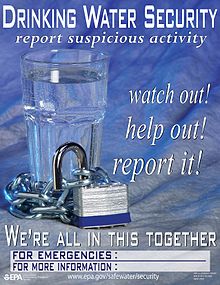
EPA drinking water security poster
Parameters for drinking water quality typically fall under two categories: chemic/physical and microbiological. Chemic/physical parameters include heavy metals, trace organic compounds, total suspended solids (TSS), and turbidity. Microbiological parameters include Coliform bacteria, East. coli, and specific pathogenic species of leaner (such as cholera-causing Vibrio cholerae), viruses, and protozoan parasites.
Chemical parameters tend to pose more of a chronic wellness take chances through buildup of heavy metals although some components like nitrates/nitrites and arsenic can have a more immediate impact. Physical parameters touch on the aesthetics and taste of the drinking water and may complicate the removal of microbial pathogens.
Originally, fecal contamination was determined with the presence of coliform bacteria, a user-friendly mark for a class of harmful fecal pathogens. The presence of fecal coliforms (like Eastward. Coli) serves every bit an indication of contamination past sewage. Boosted contaminants include protozoan oocysts such as Cryptosporidium sp., Giardia lamblia, Legionella, and viruses (enteric). [33] Microbial pathogenic parameters are typically of greatest business concern considering of their immediate wellness gamble.
Throughout almost of the world, the most common contagion of raw water sources is from human sewage and in particular human being faecal pathogens and parasites. In 2006, waterborne diseases were estimated to cause 1.8 million deaths each yr while about 1.ane billion people lacked proper drinking water. [34] It is clear that people in the developing world need to have access to skilful quality water in sufficient quantity, water purification technology and availability and distribution systems for h2o. In many parts of the world the only sources of water are from small streams oft directly contaminated past sewage.
Condom Indicators
Admission to safety drinking water is indicated by proper sanitary sources. These improved drinking water sources include household connection, public standpipe, borehole condition, protected dug well, protected leap, and rain h2o collection. Sources that don't encourage improved drinking water to the same extent equally previously mentioned include: unprotected well, unprotected spring, rivers or ponds, vender-provided h2o, bottled water (consequential of limitations in quantity, not quality of water), and tanker truck water. Access to sanitary water comes manus in hand with access to improved sanitation facilities for excreta. These facilities include connection to public sewer, connexion to septic system, pour-flush latrine, and ventilated improved pit latrine. Unimproved sanitation facilities are: public or shared latrine, open pit latrine, or bucket latrine. [35]
Water Handling
Most h2o requires some blazon of treatment before use, even water from deep wells or springs. The extent of treatment depends on the source of the water. Appropriate applied science options in water handling include both community-scale and household-calibration point-of-utilize (POU) designs. [36] A few large urban areas such as Christchurch, New Zealand have access to sufficiently pure h2o of sufficient volume that no treatment of the raw water is required. [37]
Over the past decade, an increasing number of field-based studies have been undertaken to determine the success of POU measures in reducing waterborne illness. The ability of POU options to reduce affliction is a part of both their ability to remove microbial pathogens if properly applied and such social factors every bit ease of use and cultural appropriateness. Technologies may generate more (or less) health benefit than their lab-based microbial removal performance would suggest.
The current priority of the proponents of POU treatment is to reach big numbers of low-income households on a sustainable ground. Few POU measures have reached significant calibration thus far, but efforts to promote and commercially distribute these products to the world's poor have only been nether way for a few years.
In emergency situations when conventional handling systems take been compromised, water borne pathogens may exist killed or inactivated by boiling [38] but this requires abundant sources of fuel, and can be very onerous on consumers, especially where information technology is difficult to store boiled water in sterile conditions and is non a reliable manner to kill some encysted parasites such every bit Cryptosporidium or the bacterium Clostridium. Other techniques, such as filtration, chemic disinfection, and exposure to ultraviolet radiation (including solar UV) accept been demonstrated in an array of randomized control trials to significantly reduce levels of h2o-borne disease amongst users in low-income countries, [39] but these endure from the aforementioned problems as humid methods.
Drinking water regulation
Guidelines for the assessment and improvement of service activities relating to drinking water have been published in the form of International standards for drinking h2o such every bit ISO 24510. [40]
European Matrimony
The European union sets legislation on water quality. Directive 2000/lx/EC of the European Parliament and of the Council of 23 October 2000 establishing a framework for Community action in the field of h2o policy, known as the water framework directive, is the principal piece of legislation governing water. [41] The Drinking water directive relates specifically to water intended for human consumption.
Each member state is responsible for establishing the required policing measures to ensure that the legislation is implemented. For example, in the Britain the Water Quality Regulations prescribe maximum values for substances that touch wholesomeness and the Drinking Water Inspectorate polices the water companies.
Us of America
In the Us, the Environmental Protection Bureau (EPA) sets standards for tap and public water systems nether the Safety Drinking Water Act (SDWA). [42] The Food and Drug Administration (FDA) regulates bottled water as a nutrient production under the Federal Food, Drug, and Cosmetic Deed (FFDCA). [43] Bottled water is non necessarily more pure, or more than tested, than public tap water. [44] However, there is evidence that the United states federal drinking water regulations exercise not ensure safe water, equally some of the regulations have not been updated with more contempo science. Dr. Peter Westward. Preuss, who became the head of the U.S. EPA's division analyzing ecology risks in 2004, has been "specially concerned", and has faced controversy in studies which suggest that regulations confronting certain chemicals should exist tightened. [45]
In 2022 the EPA showed that 54 active pharmaceutical ingredients and 10 metabolites had been found in treated drinking water. An earlier study from 2005 by the EPA and the Geographical Survey states that 40% of h2o was contaminated with nonprescription pharmaceuticals, and it has been reported that of the eight of the 12 nigh commonly occurring chemicals in drinking water are estrogenic hormones. [46] Of the pharmaceutical components constitute in drinking water, the EPA just regulates lindane and perchlorate. In 2009, the EPA did announce another 13 chemicals, hormones, and antibiotics that could potentially be regulated. The decision on whether or not they are sufficietly harmful to be regulated may not be decided upon until 2022 as it takes time for testing.
Drinking water preferences of other animals
The qualitative and quantitative aspects of drinking water requirements of domesticated animals are studied and described within the context of animal husbandry. However, relatively few studies have been focused on the drinking behavior of wild animals. A contempo study has shown that feral pigeons do non discriminate drinking water according to its content of metabolic wastes, such every bit uric acid or urea (mimicking faeces- or urine-pollution by birds or mammals respectively). [47]
See also
References
- ^ a b Greenhalgh, Alison (March 2001). "Healthy living - Water". BBC Health . http://www.bbc.co.great britain/health/treatments/healthy_living/nutrition/healthy_water.shtml . Retrieved 2007-02-nineteen.
- ^ a b U.South. Environmental Protection Agency (EPA). Dallas, TX (2000-05)."Chapter iii: Exposure Scenario Selection". http://www.epa.gov/earth1r6/6pd/rcra_c/pd-o/chap3.pdf . Retrieved 2007-02-19. RCRA Delisting Technical Back up Document. p. 8.
- ^ "The Benefits of Water". Cleveland Clinic. Archived from the original on 2007-01-16. http://web.annal.org/web/20070116223719/http://world wide web.clevelandclinic.org/health/health-info/docs/2700/2731.asp?index=7250 . Retrieved 2007-02-xix.
- ^ Research debunks health value of guzzling h2o. Reuters, Apr 2008.
- ^ H. Valtin, Beverage at least eight spectacles of water a day." Really? Is in that location scientific testify for "8 × 8"? Am J Physiol Regul Integr Comp Physiol 283: R993-R1004, 2002.
- ^ Negoianu, Dan; Goldfarb, Stanley (2008). "Just add water" (PDF). J. Am. Soc. Nephrol 19 (6): 1041–1043. doi:10.1681/ASN.2008030274. http://www.asn-online.org/press/pdf/2008-Media/Water%20Study.pdf.
- ^ US daily reference intake values
- ^ Maton, Anthea bj; Jean Hopkins, Charles William McLaughlin, Susan Johnson, Maryanna Quon Warner, David LaHart, Jill D. Wright (1993). Human being Biology and Health. Englewood Cliffs, New Jersey, USA: Prentice Hall. ISBN 0-13-981176-one.
- ^ World Health Organization (WHO). Geneva, Switzerland. Joyce Morrissey Donohue, Charles O. Abernathy, Peter Lassovszky, George Hallberg. "The contribution of drinking-water to full dietary intakes of selected trace mineral nutrients in the United States." Draft, Baronial 2004.
- ^ Noakes TD, Goodwin N, Rayner BL, et al. (1985). "Water intoxication: a possible complication during endurance exercise". Med Sci Sports Exerc 17 (3): 370–375. PMID 4021781. http://journals.lww.com/acsm-msse/Abstract/1985/06000/Water_intoxication__a_possible_complication_during.12.aspx.
- ^ Noakes TD, Goodwin Due north, Rayner BL, Branken T, Taylor RK (2005). "Water intoxication: a possible complication during endurance exercise, 1985". Wilderness Environ Med xvi (four): 221–7. PMID 16366205.
- ^ Schardt, David (2000). "Water, Water Everywhere." Middle for Science in the Public Interest, Washington, D.C. Accessed 2022-10-26.
- ^ Hall, Ellen L.; Dietrich, Andrea M. (2000). "A Brief History of Drinking Water." Washington: American Water Works Association. Product No. OPF-0051634.
- ^ United Nations. World Water Assessment Programme (2009). "Water in a Changing World: Facts and Figures." World Water Development Written report 3. p.v.
- ^ [1] BBC News The water vendors of Nigeria Referenced 2008-x-xx
- ^ [2] folio 51 Referenced 2008-x-20
- ^ [3] The Millennium Development Goals Study folio 44
- ^ [iv] The Millennium Development Goals Report 2009. Referenced 2008-10-20
- ^ United Nations Children'southward Fund (UNICEF). New York, NY. "Safe Drinking H2o." Excerpt from "Progress since the World Tiptop for Children: A Statistical Review." September 2001.
- ^ March 2008, Cashing in on Climate Change, IBISWorld
- ^ Africa and the Millennium Development Goals [www.united nations.org/millenniumgoals/docs/MDGafrica07.pdf]
- ^ Conroy, RM.; Meegan, ME.; Joyce, T.; McGuigan, G.; Barnes, J. (Oct 1999). "Solar disinfection of water reduces diarrhoeal disease: an update". Arch Dis Child 81 (4): 337–8. doi:10.1136/adc.81.4.337. PMC 1718112. PMID 10490440. http://www.pubmedcentral.nih.gov/articlerender.fcgi?tool=pmcentrez&artid=1718112.
- ^ Conroy, R.M.; Meegan, Thou.Due east.; Joyce, T.K.; McGuigan, Yard.1000.; Barnes, J. (2001). "Use of solar disinfection protects children under 6 years from cholera". Arch Dis Child 85 (iv): 293–295. doi:10.1136/adc.85.iv.293. PMC 1718943. PMID 11567937. http://world wide web.pubmedcentral.nih.gov/articlerender.fcgi?tool=pmcentrez&artid=1718943.
- ^ Rose A, Roy S, Abraham V, Holmgren G, George 1000, Balraj V, Abraham South, Muliyil J et al. (2006). "Solar disinfection of water for diarrhoeal prevention in Southern Republic of india". Arch Dis Child 91 (ii): 139–141. doi:10.1136/adc.2005.077867. PMC 2082686. PMID 16403847. http://www.pubmedcentral.nih.gov/articlerender.fcgi?tool=pmcentrez&artid=2082686.
- ^ Hobbins One thousand. (2003). The SODIS Wellness Impact Study, Ph.D. Thesis, Swiss Tropical Institute Basel
- ^ http://www.wateraid.org/international/what_we_do/where_we_work/default.asp
- ^ http://www.wateraid.org
- ^ Earth Wellness Organization. Global Framework for Action on Sanitation and H2o Supply (2009-07-21). "Oft Asked Questions." Working document.
- ^ a b Pearce, Fred (2006). When the Rivers Run Dry out: Journeys Into the Heart of the World'due south Water Crisis. Toronto: Key Porter. ISBN 9781552637418.
- ^ Bagla, Pallava (2003-06-05). "Arsenic-Laced Well H2o Poisoning Bangladeshis". National Geographic News (Washington: National Geographic Guild). http://news.nationalgeographic.com/news/2003/06/0605_030605_arsenicwater.html.
- ^ Bagchi, Sanjit (2007-11-20). "Arsenic Threat Reaching Global Dimensions". Canadian Medical Association Periodical 177 (eleven): 1344–45. doi:10.1503/cmaj.071456. ISSN 1488-2329. PMC 2072985. PMID 18025421. http://www.cmaj.ca/cgi/reprint/177/11/1344.pdf.
- ^ WHO/UNICEF, Water for life: making it happen
- ^ EPA. Washington, D.C. "Drinking Water Contaminants: Microorganisms." 2022-09-21.
- ^ U.Southward. Centers for Disease Command and Prevention. Atlanta, GA. "Safe Water Arrangement: A Low-Cost Technology for Safe Drinking Water." Fact Canvas, World Water Forum 4 Update. March 2006.
- ^ Meeting the MDG Drinking Water and Sanitation Target: A Mid-Term Cess of Progress [www.who.int/water_sanitation_health/monitoring/jmp04.pdf]
- ^ Center for Affordable Water and Sanitation Technology. Calgary, Alberta. "Household Water Handling Guide," March 2008.
- ^ Christchurch City Council. Christchurch, NZ. "Our water - Water supply." Accessed 2022-x-26.
- ^ World Health Organisation, Geneva (2004). "Guidelines for Drinking-water Quality. Volume 1: Recommendations." third ed.
- ^ Clasen, T.; Schmidt, W.; Rabie, T.; Roberts, I.; Cairncross, S. (2007-03-12). "Interventions to improve water quality for preventing diarrhea: a systematic review and meta-analysis". British Medical Journal 334 (7597): 782. doi:ten.1136/bmj.39118.489931.Be. PMC 1851994. PMID 17353208. http://www.pubmedcentral.nih.gov/articlerender.fcgi?tool=pmcentrez&artid=1851994.
- ^ ISO 24510 Activities relating to drinking h2o and wastewater services. Guidelines for the assessment and for the improvement of the service to users
- ^ Maria, Kaika (April 2003). "The Water Framework Directive: A New Directive for a Changing Social, Political and Economic European Framework". European Planning Studies, (Taylor and Francis Grouping) xi (three): 299–316. doi:x.1080/09654310303640. http://www.informaworld.com/smpp/content~content=a713666358~db=all . Retrieved 2009-02-10.
- ^ Pub.Fifty. 93-523; 42 U.S.C. § 300f et seq. December sixteen, 1974.
- ^ June 25, 1938, ch. 675, 52 Stat. 1040; 21 The statesC. § 301 et seq.
- ^ EPA. "Ground water and drinking water - Customer Service." Accessed 2022-ten-26.
- ^ Duhigg, Charles (2009-12-xvi). "That Tap Water Is Legal but May Be Unhealthy". New York Times: p. A1. http://www.nytimes.com/2009/12/17/us/17water.html?em=&pagewanted=all.
- ^ http://blogs.ei.columbia.edu/2011/10/05/pharmaceuticals-in-the-water-supply-is-this-a-threat/
- ^ Olah G, Rózsa Fifty (2006). "Nitrogen metabolic wastes do not influence drinking water preference in feral pigeons". Acta Zoologica Academiae Scientiarum Hungaricae 52 (4): 401–406. http://www.zoologia.hu/list/olah_rozsa.pdf.
External links
- National Pesticide Information Centre - Pesticide in Drinking Water Fact Sail
- National Pesticide Data Heart - Antimicrobials for Nutrient Processing and Drinking Water Systems
- Drinking water at the Open Directory Projection
- U.South. Centers for Disease Control and Prevention (CDC) Good for you Water - Drinking H2o One-finish resource for drinking water including information on tap water, water wells, fluoridation, water testing, water-related diseases and contaminants, etc., plus links to EPA, WHO, and other resource
- U.s.a. Environmental Protection Agency - National drinking water program - Full general info, regulations & technical publications
- WHO - Water Sanitation and Health: drinking water quality
- WHO - Water Sanitation and Health: potabilization systems
- The International H2o Association
- Waterwedrink - Links to worldwide drinking water quality websites
- COVSA American veterans raise money for condom water wells in Vietnam
- UNICEF State of the World's Children 2009 Full Written report with Statistics
- In Historic Vote, United nations Declares Water a Central Homo Right - video report by Commonwealth Now!

Source: https://en-academic.com/dic.nsf/enwiki/130655
Posted by: elliottcoccousturia1984.blogspot.com
0 Response to "What Does The Clean Water Act Do For Our Drinking Water"
Post a Comment